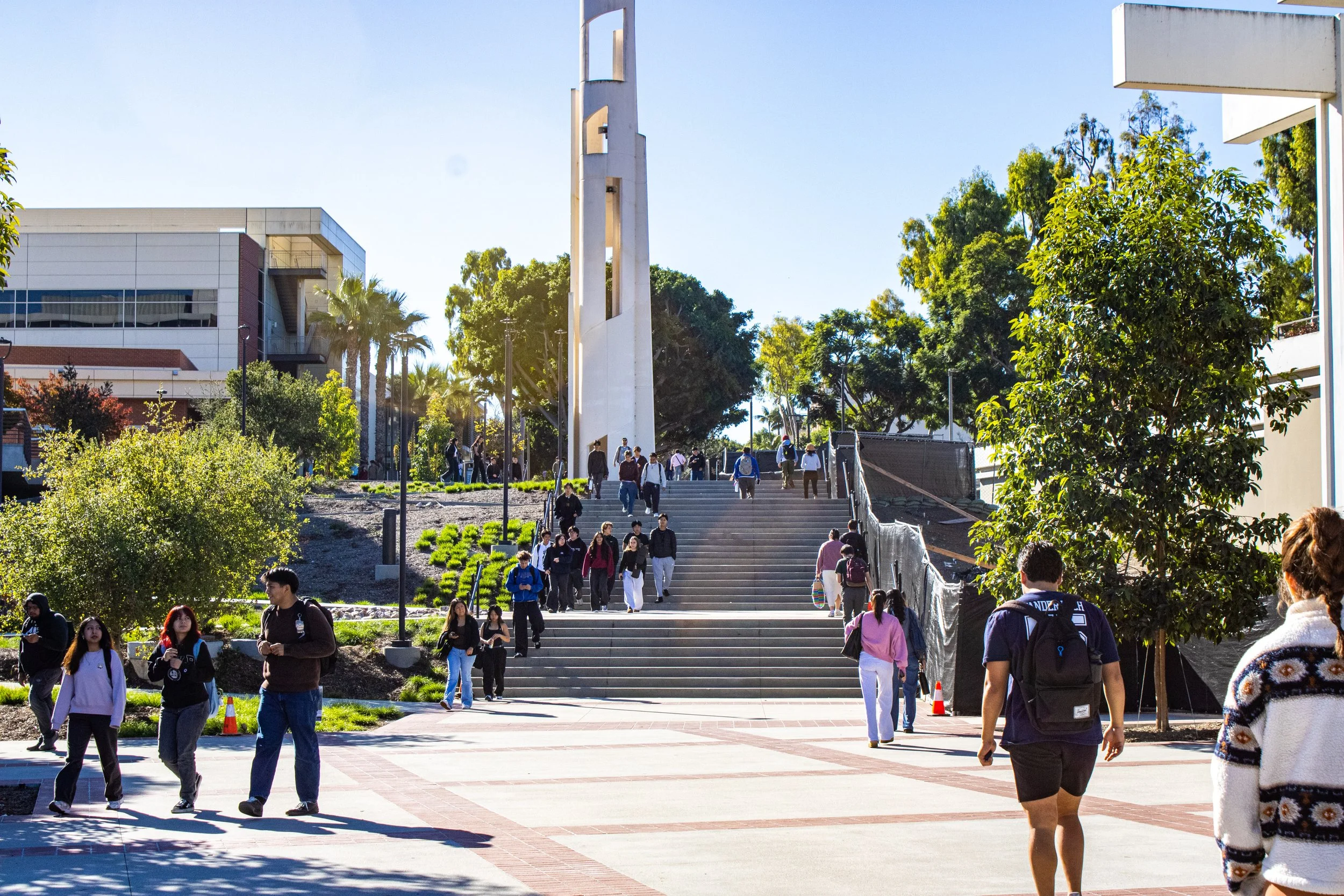
Cal State Long Beach campus on Dec. 4, 2025. Photo by Yalina Harris.
Most college students are no strangers to taking out a loan without a concrete plan to pay them back; the California State University system is no different.
On Nov. 30, 2025, the California State University Board of Trustees accepted a $144 million no-interest loan from the state of California. The loan must be paid back by July 1, 2026, assuming no extensions are given. The loan will be used to give a one-time bonus to all CSU faculty and staff. The decision to take out the loan has been met with controversial views and a mix of misinformation.
What led to this decision?
The decision to take out the $144 million loan is a trickle-down effect that began long ago in 2022, when the CSU and UC funding compact agreement was established with the state. This compact promised the CSU and UC systems a 5% increase in state funding each year from 2022 to 2027 barring the CSU implemented specific policies. This mutual CSU and UC compact agreement promised that the state would give about $1 billion in funding to the CSU system.
This compact was later readjusted due to the CA Budget Act of 2025. The new budget act did not fulfill Governor Newsome's original 2022 promise and ended up cutting roughly $143.8 million in on-going funding from the CSU budget. It also deferred roughly $144 million dollars from the 2025-2026 fiscal year budget to the 2027-2028 fiscal year.
This deferral of funds is what led the CSU board to take out this no interest loan without a concrete repayment plan. Patrick Lenz, interim executive vice chancellor and chief financial officer for the CSU board of trustees, said that the CSU has the money to pay the loanback in the emergency fund, however this is not an emergency. Lenz is also hopeful that the governor will fulfill the original funding promise.
“If in fact, the governor's January budget fully repays the base funding and provides the $252 million of additional funding, or the 5% represented by the compact. Repaying the loan will not be a problem,” Lenz said.
Union perspectives
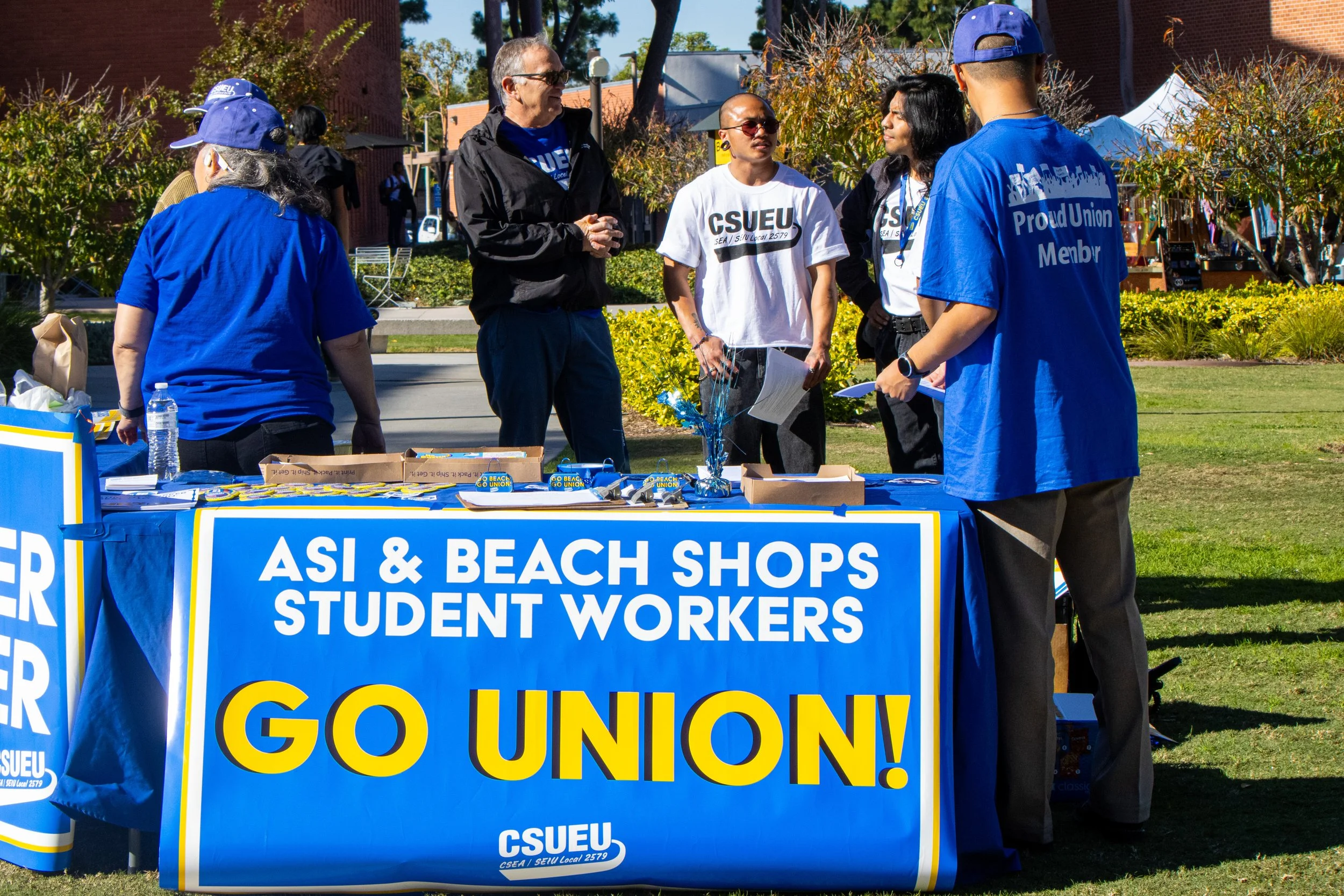
A student protest was held on Dec. 4, 2025, with the CSUEU, to campaign for better working conditions for student ASI workers, on the Cal State Long Beach campus quad. Photo by Yalina Harris.
The people most affected by the loan are CSU faculty and staff; many labor unions have mixed emotions about the bill. But one thing is clear: some union members are confused, and tensions are continuing to build over the next fiscal year as union members, and the Chancellors' offices begin renegotiating salary contracts. One stipulation of the bill is that the Unions will need to discuss how the $144 million no-loan will be distributed to faculty and staff.
“These things can be prolonged quite a bit; I imagine the conversations may go into the spring,” said Lenz.
The bargaining can take longer because the funds are only a one-time bonus. The loan in the short term is a win but guarantees no long-term increase or any match to retirement funds. The California Faculty Association, the largest CSU union made up of 29,000 faculty members, originally favored the loan under the pretense of greater change such as restoring cut faculty and student programs.
“We were originally pushing to restore all these programs and majors, like at Sonoma state. some students were literally finding out a week before classes started, that they didn't have a major anymore,” said Elaine Bernal, a lecturer at the Department of Chemistry and Biochemistry at Cal State Long Beach and a senior board member of the CFA.
Bernal said while the CFA is still mostly in favor of the loan, there is still a need for transparency and long-term solutions from the CSU. There is also a concern about how exactly the loan will be repaid, and who will be footing the bill in the long term.
The California State University Education Union is another labor union that represents custodial staff, clerical workers, and student employees; they share a similar opinion about the loan. Roger Maxim president of the Long Beach chapter, 315, said the loan is one of those things where, “you gotta take what they give you.”
Maxim said that in his opinion the main tension with the CSU is the decision to give some CSU presidents raises amid everything else that’s going on.
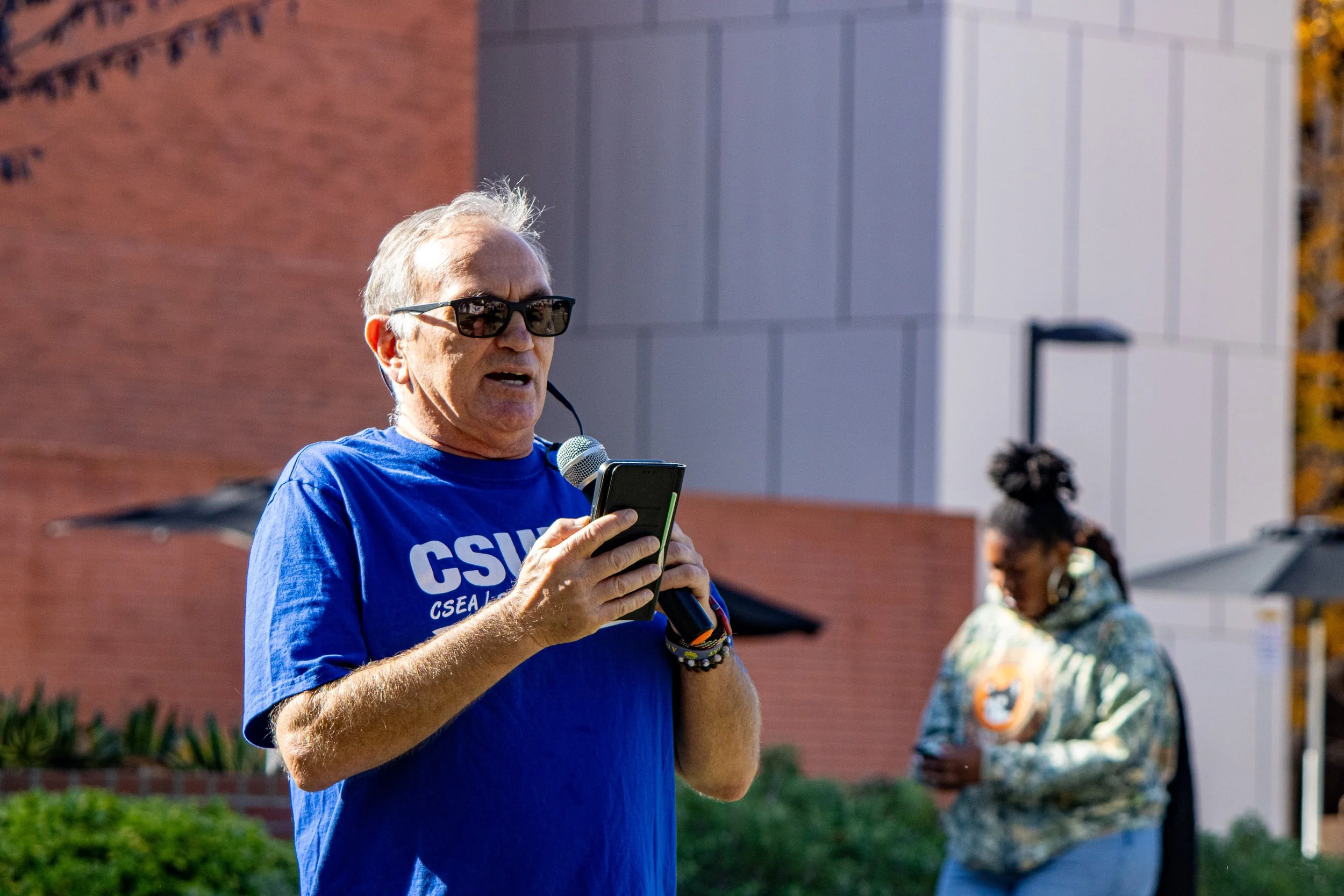
Robert Maxim, CSUEU chapter 315 president, speaks at a student protest to campaign for better working conditions for ASI workers held on Dec. 4, 2025, on the Cal State Long Beach campus quad. Photo by Yalina Harris.
“It's bad when we haven't had a raise system since the 90’s, partially because we had weak union participation. So, they're [CSU board of trustee’s] claiming there's no money, when these people are already fat cats, when they come into being a president they're given a car, a house,” Maxim said.
Maxim is referencing a November CSU board of trustees' decision to raise select CSU president salaries ranging from 5% to 20%.
What about the students?
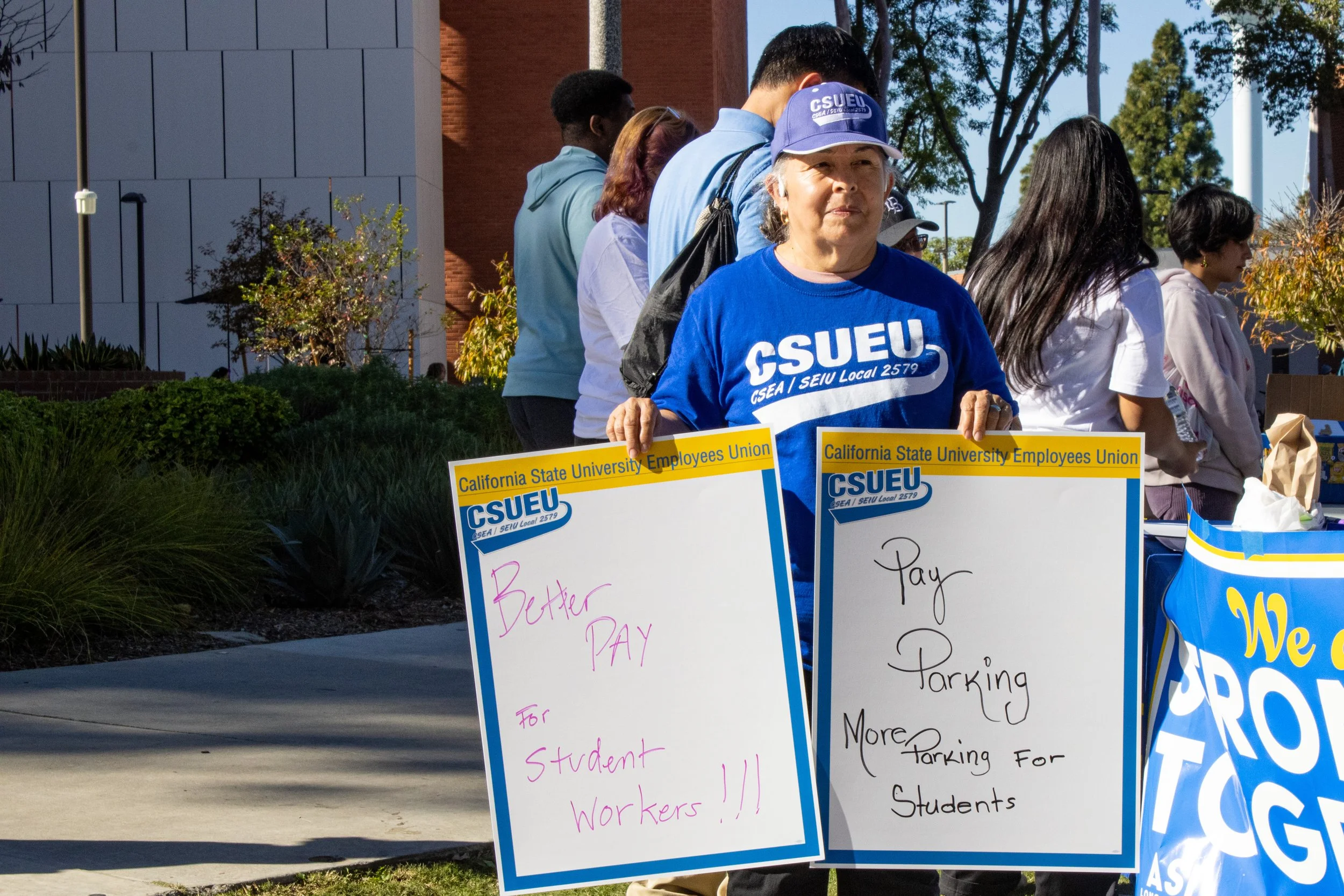
A student protest was held on Dec. 4, 2025, in conjunction with the CSUEU to campaign for better working conditions for student ASI workers, on the Cal State Long Beach campus quad. Photo by Yalina Harris.
Students are not exempt from these union discussions and concerns about the no-interest loan. The CSUEU is starting a campaign for student employees, specifically ASI student workers, to get involved in negotiations. Giselle Garcia is a student organizer and food service worker on campus. She helped in organizing a student protest for the student chapter of the CSUEU on Dec. 4, 2025.
“We're organizing to get better working conditions, better working hours, set schedules, paid parking, or designated parking for us,” Garcia said.
While some students are siding with unions and advocating for the CSU to pay up, there are many student misconceptions still surrounding the no-interest loan. The main narrative is that students are going to pay in the end, just as they are for the University Student Union upgrades on campus.
“We're being charged extra for the USU, and we can't even use the USU. I'm not even going to see that. So, it kind of sucks. Like, we can’t even use the USU, and we’re getting charged for it,” Gacia said.
While raised tuition and reconstruction is a mounting student's concern on CSULB specifically, it is not the answer for everything and will not be used to pay the no-interest loan back.
When addressed with rumors about student tuition being raised to pay for everything the CSULB administration maintains that:
“Regarding “rumors circulating campus” and the USU renovation: Funding for the USU renovation, a project of Associated Students, is unrelated to revenue from tuition and unrelated to allocations from the state via the CSU,” Jeff Cook, the CSULB Associate Vice President, said.
The controversy of the no-interest loan is ongoing, and as wage discussions continue and budget cuts grow, people will be discussing these events well into next year. The CSU system has already cut out a combined 1,430 courses, eliminated 7.3% in student support services, and removed about 823 staff and faculty positions. This cut coupled with raised tuition, and loan tension is a key point of controversy as the future of CSU funding is uncertain.
Overall, Lenz assured that the board is doing everything in its power to, “protect the academic and student services side. But with additional cuts, it just makes it so much more challenging.”
