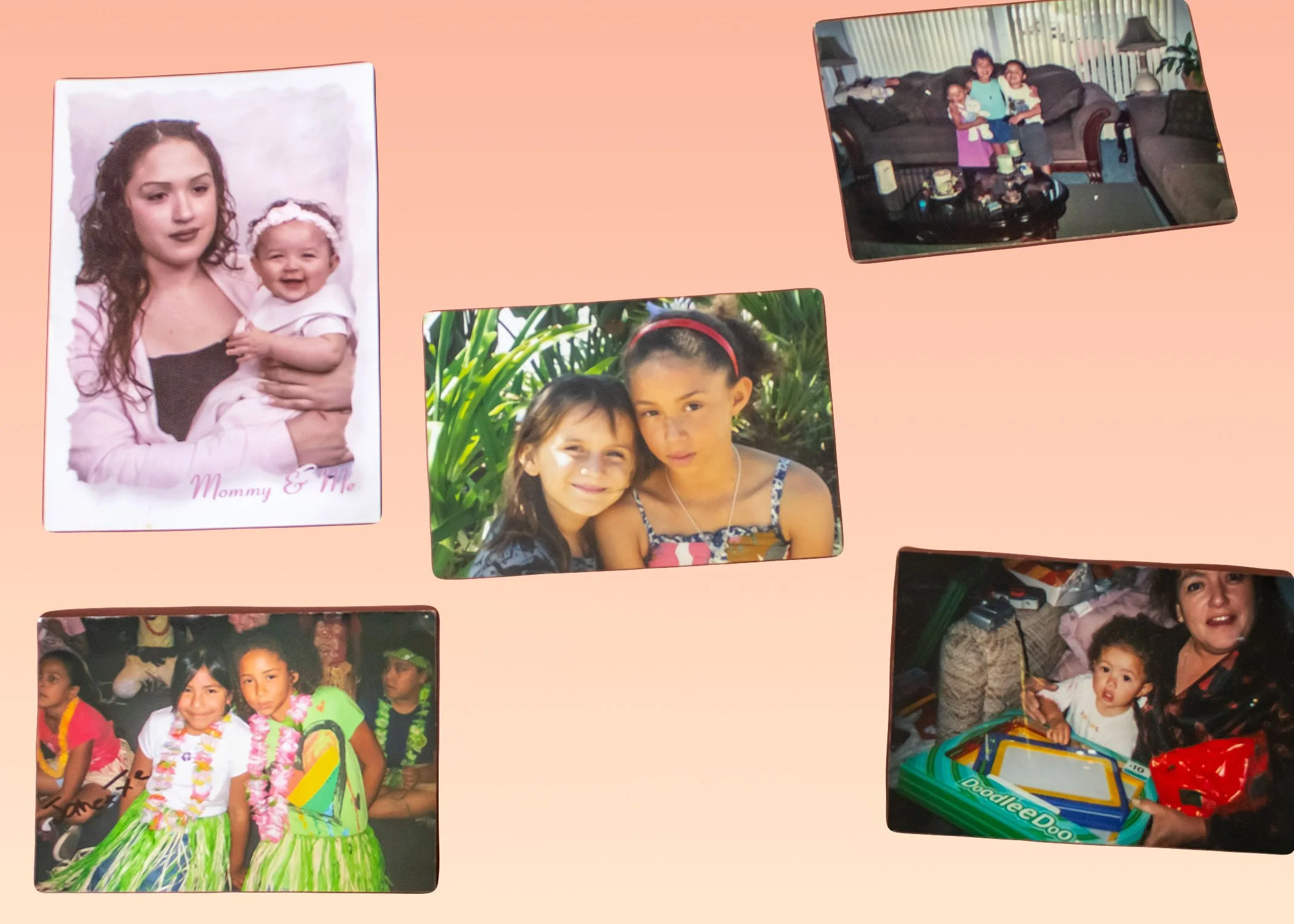
Collage of younger photos of me in and out of foster care. photo by Yalina Harris
The car rolled into the driveway, just as a third tear slid down my face.
“It’s okay, you’ll see her again.”
“I just want to go home,” I whimpered.
“Well… that might never happen...”
Those words hit me harder than a ton of bricks. Tears began to flow faster than I could bear, I had to fall asleep. I said goodbye to the social worker, whose name I can’t even remember today. It was the most soul-crushing news of my life, and I’ll never know who to share the memory with.
I cried all night. I can’t remember the last time I saw my mom’s face, but I remember the tears I cried, and more so the tears I held in. From the time I was five to thirteen years old, I rotated in and out of the foster care system with my two younger siblings.
The reality that I would never see my mom again, at ten years old, as that car rolled into the driveway, was news I wasn’t ready to hear. I felt my world was over. Like leaving the neglect of my heroin addict parents was a curse.
I felt like it was a curse to leave the neglect of my heroin addict parents. I had childish notions that they would change and we would be happy. I had even more childish notions that when I was with them, I was truly happy.
My childhood was unconventional, to say the least. I was born in jail and later lived on a stolen sailboat in San Diego County before entering the foster system. As I walk by you on campus, you would never know the scars I wear, and sometimes neither do I.
All that's visible now is the responsibility I bear from the neglect. Neglect is not a word I previously associated with my childhood. I am a glass-half-full person. I didn’t truly recognize the neglect until recently, as I sat in my dentist's chair.
I was getting the plaque aggressively scraped off of my teeth when a tear rolled down my face. The shooting pain in my gums was just the first of many reminders of the neglect.
“You have periodontal disease,” Dr. Jessica Smith said.
Her disapproving glance made me feel like a leper. Still, I didn’t think too much of it after the appointment. Periodontal disease is a chronic bacterial infection that destroys the gums and bones that support the teeth. According to the National Institute of Dental and Craniofacial Research, about 30% to 40% of people in their twenties have periodontal disease.
Many factors can cause it but the primary cause is poor dental care. I felt a bitterness as Dr. Smith explained this. I brushed. I flossed. But I didn’t come in for regular cleanings for years before my twenties. I was stressed and mortified by my own naivety and feelings of failure.
To be clear, this wasn’t a death sentence. Honestly, it just meant I needed to get more frequent $200 teeth cleanings. Still, this inconvenience was just another weight in my chest. It was another realization that simple things that my peers already had the hang of, and had support with throughout childhood would be a skill I’d have to master alone.
“Don’t slack off. Stay on top of dental cleanings. Don’t take a day off. Don’t forget bills, don’t forget it’s all on you.”
These worries about adulthood were ones I shared with all of my classmates, but the weight of them I bore all alone. The weight of these responsibilities hit this year during midterms. My minorly inconvenient periodontal disease, combined with an ear infection, resulted in a throbbing gum infection that lasted weeks.
The pain was just another reminder of the neglect. I had to take a week and a half off from school and work, only showing up for midterms. On the third day, I laid in bed with shooting pain in my mouth, a swollen tongue, a fever, and a migraine. Normally, this would be miserable, but my boyfriend was cuddling next to me. He grabbed me medicine, and put on my favorite cartoon — Ratatouilli.
Even though I felt terrible, I realized something: the love I had and the security I felt, weren't things I previously associated with being sick. Weirdly, this became another reminder of the neglect. Over the next few days, I continued healing, taking antibiotics, and eventually went back to work.
On my first shift back, my mouth was still swollen, my tongue was in pain, and I could barely talk. I work as a receptionist at a yoga studio checking people in for class, so talking is somewhat essential.
“I have periodontal disease, and my mouth got infected,” I repeated throughout the shift, my words slurred by swelling.
I began to realize that periodontal disease was not as common as I once thought. I started researching it, trying to understand how I got it. That’s when it hit me: the neglect of my childhood had left scars I couldn’t always see. I spiraled after this realization, thinking about all the times I felt different because of my experience in foster care.
When my boyfriend shares a story about his summer family bike rides at ten years old, I think of the times I got to go to church with my foster family. Both are happy memories, but they aren’t quite the same. They don’t share the same nostalgia. Mine are layered with pain, instability, and a longing for a “normal” family.
For a long time these experiences made me feel alone, like an outsider. But the reality isn’t that lonely. According to the Adoption and Foster Care Analysis and Reporting System estimates, there are about 328,947 children in the child welfare system. Kids who will experience struggles and loneliness similar to mine. Of those kids, roughly 69% to 85% of them will complete a high school diploma or GED, compared to 95% of young people overall. Even fewer — about 8% to 12% — will earn a college degree.
As I recovered from being sick and got right back into the throws of school, work and extracurriculars, I realized how lucky I truly am. I was on the positive side of a statistic, I have a community around me that supports me.
Yes, I have periodontal disease. Yes, I have family dynamic issues that will need to be addressed in therapy. But what this experience taught me was the resilience I have.
It made me realize why I never labeled my childhood experiences as neglect before: the only thing we truly control in life is our perspective, and our mindset. Since that day at ten years old, when my childhood shifted forever, I have chosen to leave the tears on my pillow and lead with strength.
